
What more is there to sustainability solutions – other than cost and efficiency and compliance and cutbacks?
What’s beyond EVs, solar panels, recycling, cutting back and voting for change?
There’s a world of “why we can’t” myths – let’s start by busting a few of them:
How do you find your piece of the action?
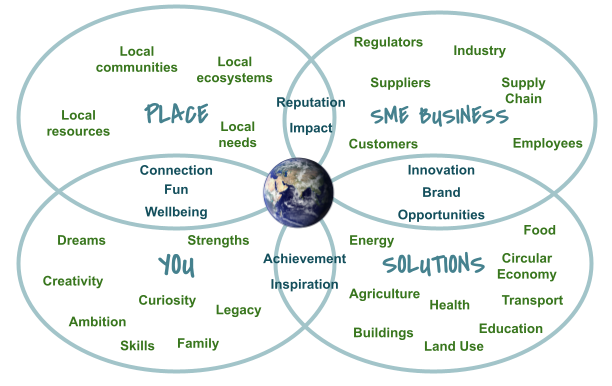
Starting points and practical links
This web page is built with Melbourne SME businesses in mind and includes:
- Links to selected commercial solutions catalogues showing the full range of what’s happening commercially and in local communities.
- Links connecting you to key innovation principles driving today’s solutions.
- Links to Victorian and Australian local examples.
- Links to practical tools/processes to help you get started.
SME action examples and ideas
See it big – so you can keep it simple
Big picture, what’s going on is:
- A growing recognition that the last 200 years of “extract/use/dump” design is pretty toxic for the 20km layer of biosphere that delivers our food, water, air, resources and weather.
- A growing recognition that “extract/use/dump” is ALSO massively costly way of doing business.
This has led to 30+ years of entrepreneurial innovation – solutionists building models that restore and regenerate ecosystems and communities AND business bottom lines.
Get strategic about your customers and their industries
Find out what developing trends are likely to affect your clients and customers – including where their opportunities lie:
General SME operations
Business property owners
Business coaches / consultants / service providers
Find out what your clients core (often unspoken) concerns are, and how you can add value using free tools such as:
- This Sustainability in Business Starter Kit
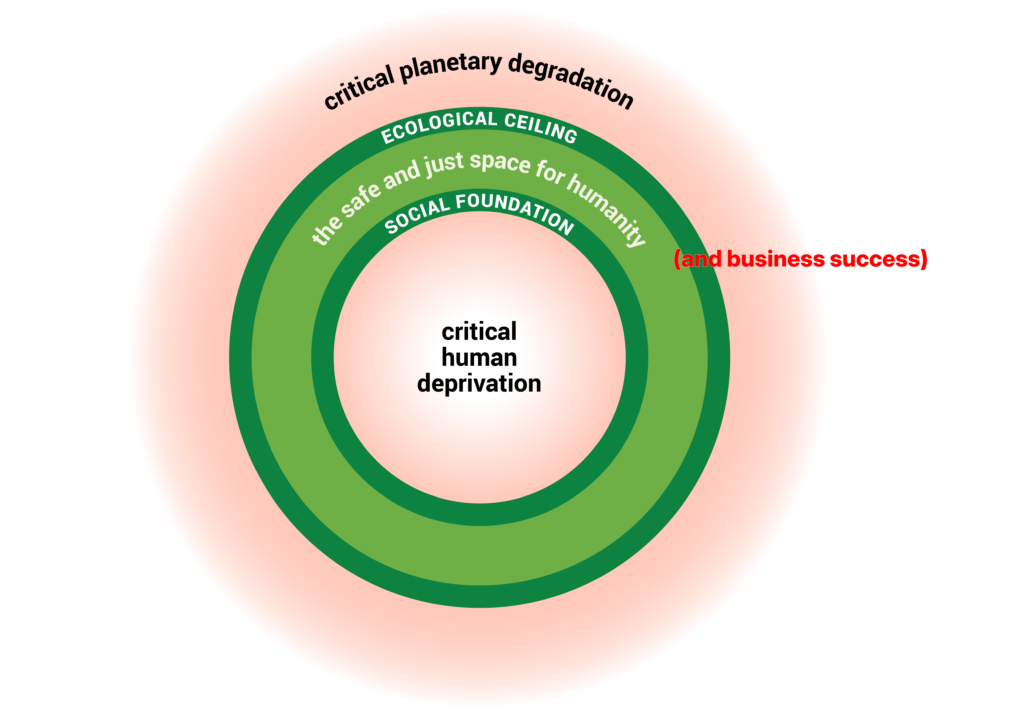
- Or this Doughnut Design for Business Tool
- Or talk to me about what else is available….
Got young people in your circle?
If you know anyone considering their career options (or worried about the future), then they might be interested in this article on the Top Green Jobs in Australia: What’s in Demand Right Now?
And what could be better for the anxious (of any age) than exploring a career in fixing the systems issues? Nearly any job could “go circular” but these five positions are critical to accelerating circularity
Looking for new horizons? Personally or in business?
In our January get-together, one member said: “I’m over my business – it’s time for a change. I don’t know what, I’m not ready to retire, but I want something new.”
Identify your signature strengths, do a bit of values clarification work (with one of the group’s coaches?) AND explore Project Regeneration for inspiration.
Influence
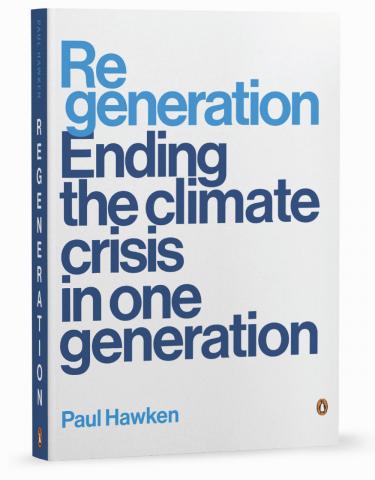
- Put a copy of REGENERATION in your reception area.
Creatives and communicators
Simplify and visually communicate regenerative solutions, including: basic concepts; next generation design approaches, and the supporting mental models.
(I’ve done 3 websites and various updates over 20+ years – and still struggle to find meaningful images to use in a business context.)
Write SEO advisory articles on:
- “How to rank higher” for sustainability businesses.
- “How to toot your sustainability horn without getting done for green-washing”.
Article/opinion piece on sustainable website design – pros and cons.
Staff activities/offers for young demographic (generally more environmentally engaged). So consider.
- Run group cooking class on cooking plant-rich food.
- BYOD buying group for Framework PCs.
Future strategy decisions:
- Aim for cowork spaces that have secure bike parking (enabling bikes and eBikes), public transport access, are renewably powered, etc.
An action list to get started exploring…
Some other useful starting points to explore the bigger picture
Places where you can look in order to get a better view – without too much “should” stuff – and uncover your opportunities to influence, engage and build your business and your community.
Is practical in-house action POSSIBLE for small businesses?
Lets define “practical” first. What does “practical” mean to your business in your industry?
More people in more businesses – big and small – are adapting to the increasingly obvious reality that the ecosystems and communities they operate within are NOT infinite-capacity resources. And they’re looking for opportunities in this fundamental world-view shift. That’s increasingly likely to include your major customers and your competitors.
So waiting for “policy change” is an increasingly risky strategy. So it simply good sense to:
Local / Australian Examples
Networks and groups
Melboune’s local Doughnut Economics chapter is Regen.Melbourne – and here are some stories of the Melbourne Doughnut.
The Australian Circular Economy Hub connects local actionists. Free to join.
Deakin Uni’s Circular Cities program uses the Doughnut Economics framework and tools.
Totally Renewable Yackandandah got started back in 2014, and has progressed from community buying group to virtual power plant, spinning of a commercial energy retailer along the way.
Circular regions
Bega Valley is out to be the world’s most circular region.
Greening cities and suburbia
Micro-forests, revegetation and Re-imagining Nature Strips.
Urban rooftop farming, such as Melbourne SkyFarm.
Collaborative regeneration projects like Domaine/Melbourne Water/Regen Nurseries in the Yarra Valley
Energy beyond solar
Small scale water turbines in Marysville and Warburton. Also in Melbourne Water storages.
Combined heat and power make the most of energy and its by-product heat. One small UK data centre is heating the water for the next-door swimming pool.
The best kilowatt you can buy is a “negawatt” – the energy you DON’T use. Building efficiency retrofits utilising IoT technology are increasingly cost effective.
Industries and markets
Trades and residential construction
Jamie Durie’s Future House series showcased new approaches: prefab, tilt slab and 3D-printed residential builds. (What does it mean for the building industry?)
Next-generation electric utes with Vehicle to Load capability which can power a worksite for the day, or a home for 3 days. And Aussie engineering entrepreneurs are doing conversions to make them fit for Australian conditions.
The Cape sustainable housing development (Cape Patterson).
Aged care
Solar – not just panels/battery but participation in local Virtual Power Plants (Yackandandah).
Food issues are impactful for communities and ecosystems – from Maggie Beer doing better food for elders to reduced food waste.
Diaper recycling is becoming feasible for incontinence products.
Farming
Agroecology and Food Sovereignity Alliance are working on better, fairer agriculture.
Farmers for Climate Action – has a Climate-Smart Farming Toolkit.
Agrivoltaics (solar over crops / livestock) is increasing farm productivity, farm income and renewable energy. (Everything from better wool quality to more lettuces.)
Manufacturing
Australian Circular Economy Hub – free online networking platform.
Beyond Zero Emissions Repowering Manufacturing resources.
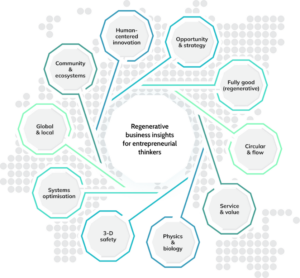
Often it’s our thinking habits that hide opportunities
How we think about “this sustainability thing” limits the actions we can see. Make sure you’re not missing out.
| Old Thinking | New Thinking |
| Obligation, government/corporate policy, compliance, cost, reporting… | Opportunity, creativity, business innovation, community development, ecosystem benefits. |
| Sustainability = “doing less harm” through reductions, efficiency in current processes. | Regeneration and restoration and innovation – designing for better from the start, across communities, ecosystems and local economies. |
| Big players push global solutions outwards and from the top down. | Business and communities apply global AND local know-how to generate local win/win/win solutions. |
| Extractive, linear systems dating back to “infinite nature” thinking. | Circular, beneficial systems DESIGNED for upcycling resources. |
| Push more products, in higher volumes, and further afield. | Deliver more value using less resources. |
| Defaults to resource-intensive mechanical and chemical engineering processes | Expands solutions thinking to include biology-based and physics-based processes |
| Settles for “managable” toxicity as “the best we can do”. | Designs for 3D safety – to make/use/dispose for ecosystems/people/economies |
| Focuses on process-level improvements. | Seeks to optimise systems-level results and performance. |
| Big players push global solutions outwards and from the top down. | Local solutionists apply global AND local know-how to generate local win/win/win solutions. |
| Business is independent of and separate from it’s host ecosystems and communities. | Business depends on functioning communities and ecosystems for long term survival and growth. |
| Rational economic, self-interested decisions from commercial systems, groups and individuals. | Emotional, loss-averse, short-sighted, status-conscious behaviour from change-resistant human systems. |
A regenerative take on F.I.R.M. (for word and ideas junkies)
F = Flourishing together – communities, SMEs and ecosystems flourishing together – by design through skilled systems innovation practices.
I = Innovation – upgrading the production, supply and economic systems that design, build and deliver the products and services we use every day. (Through invention and research transformed into business innovation, which often happens well ahead of “government policy”.)
R = Regeneration – because “less harm” solves nothing – and regeneration is
M=Mutuality – ecosystems, communities and economies as partners.